Content
Is It Safe to Let AI Work on Your Business?
Connecting AI to a real business is more powerful than asking it questions in a chat window.
It also creates more responsibility.
If an AI can inspect code, read logs, work with a database or run commands, the important question is no longer only:
What can the AI do?
It is:
What is the AI allowed to do, how is that access controlled, and what happens when something goes wrong?
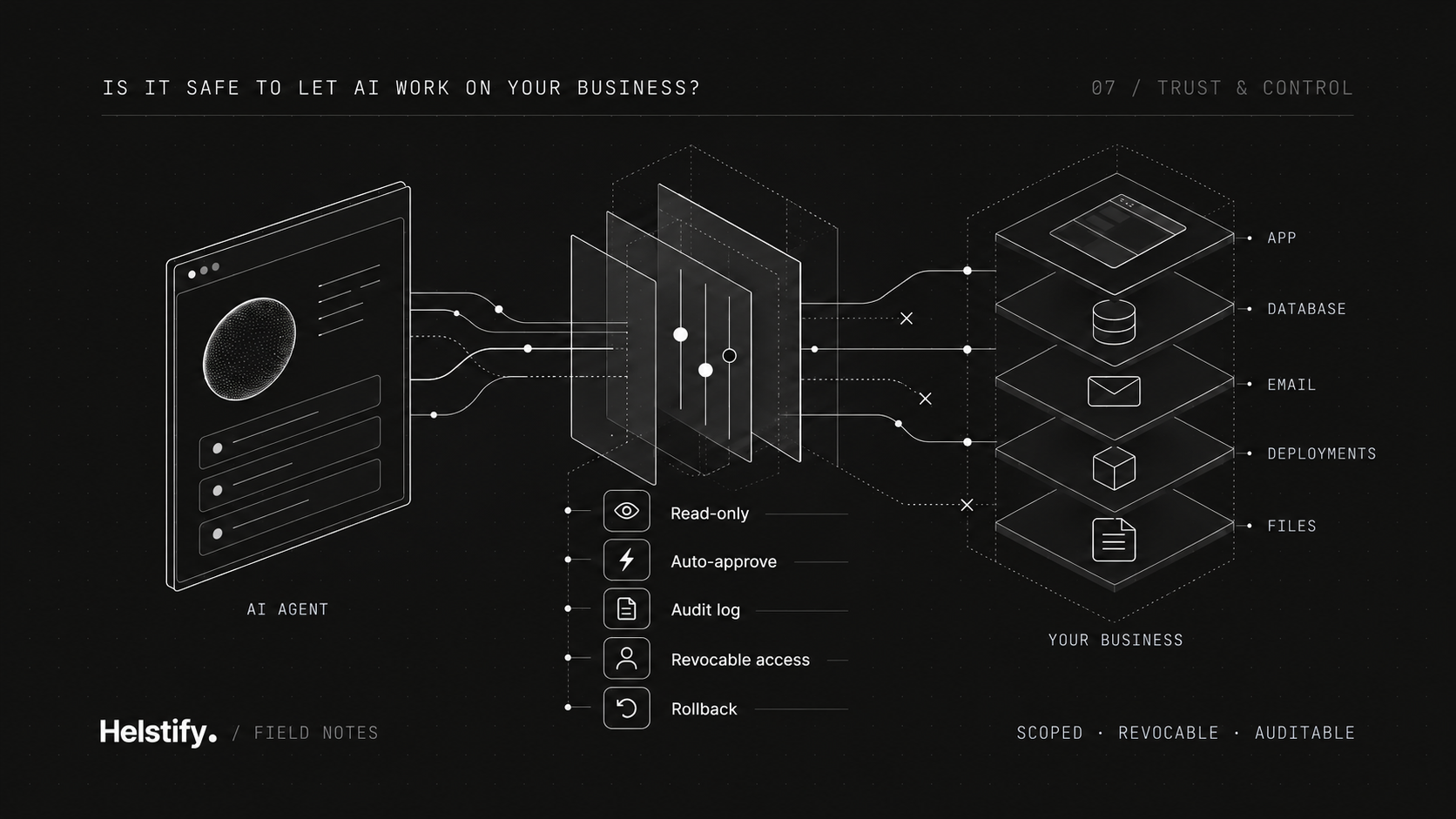
Quick answer: Giving an AI agent access to business systems is not risk-free. A safer operating model uses scoped permissions, Read-only access when inspection is enough, execution authority only when action is required, revocable access, visible activity records and recovery options. Helstify provides the operating environment and permission controls. The business owner decides what access to grant and remains responsible for actions taken through the account.
Is it safe to give an AI agent server access?
There is no useful answer that begins with an unconditional yes.
Giving any software the ability to change a live server creates operational risk.
AI adds another variable because the system is interpreting instructions rather than following only a fixed sequence of commands.
The better question is:
Can the access be limited to what the task requires?
A practical control model should let you answer:
| Question | Why it matters |
|---|---|
| What can the AI see? | Inspection itself can expose sensitive information |
| What can the AI change? | Write access can affect production |
| What tools can it use? | Tool access determines what actions are possible |
| Can access be changed? | Permissions should not be permanent |
| Are actions recorded? | You need a record of what happened |
| Can a bad change be reversed? | Mistakes need a recovery path |
| Who remains responsible? | AI does not remove business accountability |
Helstify is designed around scoped, revocable permissions rather than assuming every connected AI should have unrestricted control.
For the connection model, see Connect Your AI to Your Business and Let It Work.
What is Read-only AI access?
Read-only access is useful when the connected AI needs to inspect and analyse without making changes.
That can include tasks such as:
“Review the application and tell me what is wrong.”
“Inspect the logs and explain why the last deployment failed.”
“Check the code and identify the likely issue.”
The principle is simple:
Seeing does not have to mean changing.
Read-only is a sensible starting point for diagnosis, review and investigation.
It is also useful when you want to understand how the AI approaches a problem before granting execution authority.
What is Auto-approve?
Auto-approve is an execution mode.
It allows the connected AI to perform permitted work without stopping to ask for confirmation before every individual action.
Depending on the tools and scopes available, that may include actions such as editing files or running commands.
Auto-approve should not be interpreted as:
“The AI can now do anything.”
The intended model is:
The AI can execute within the access you have granted.
Execution authority should match the risk of the task.
Is Auto-approve safe?
Auto-approve increases convenience.
It also increases the consequences of a bad instruction, an incorrect assumption or an AI mistake.
Whether it is appropriate depends on the task.
| Situation | Sensible starting point |
|---|---|
| Reviewing code | Read-only |
| Investigating logs | Read-only |
| Understanding a production issue | Read-only |
| Editing a low-risk page | Execution may be appropriate |
| Changing authentication | Greater review may be appropriate |
| Modifying important production data | Strong controls and recovery planning |
| Making a consequential financial action | Human oversight appropriate to the risk |
There is no universal permission setting that is correct for every business.
The useful principle is:
Grant the minimum authority needed for the work you want done.
Can I control what my AI agent can change?
Helstify's current permission model allows access to be scoped and changed.
Its public product material also distinguishes controls enforced outside the model from instructions that simply ask a model to behave in a certain way.
That distinction matters.
There is a difference between telling an AI:
“Do not use this capability.”
and not giving the AI that capability in the first place.
A security boundary is stronger when access is enforced by the surrounding system rather than depending only on the model following an instruction.
The exact tools and scopes available depend on the environment, plan and connected systems.
Can I change or revoke AI access?
Yes.
Helstify's current public documentation describes agent access as scoped and revocable.
That matters because the permission appropriate during a build may not be the permission you want during normal operations.
For example, you may temporarily allow execution for a specific task and narrow the scope again afterward.
Connected third-party services may also have their own permission and revocation controls.
Can I see what the AI changed?
Helstify records agent actions in an audit log.
This creates visibility into what the AI changed or ran within the environment.
That is useful for both trust and debugging.
If something goes wrong, useful questions include:
What did the AI do?
What changed immediately before the problem?
Which action or command was involved?
An audit trail does not prevent mistakes.
It makes agent activity less opaque.
What happens if the AI makes a mistake?
Assume that mistakes are possible.
AI can misunderstand an instruction.
It can make a technically plausible but incorrect change.
It can act on incomplete information.
It can also produce a change that works in one context but causes a problem elsewhere.
A responsible operating model therefore needs more than permissions.
It also needs:
- visibility
- version history where applicable
- backups appropriate to the data
- rollback or recovery paths
- human judgment for consequential actions
The goal is not to make mistakes impossible.
The goal is to limit the possible impact, understand what happened and have a recovery path.
Can I roll back an AI deployment?
Where application versioning and rollback are available, rollback provides a way to return to an earlier working application version.
That is useful whether the problematic change was made by an AI or by a person.
Rollback should not be confused with database recovery.
Rolling back application code may restore an earlier application version.
It may not restore data that has been deleted or altered.
For production systems, code rollback and data recovery should be considered separately.
For the broader production model, see How to Take an AI-Built App from Prototype to Production.
How are credentials and secrets protected?
Applications and AI agents often need credentials to work with business systems.
These can include:
- API keys
- database credentials
- mailbox passwords
- authentication secrets
- third-party service tokens
Helstify's current Privacy Policy states that API keys, mailbox passwords and tool secrets stored by Helstify are encrypted at rest.
It also says full API keys are not logged, and that tool secrets are scoped and revocable.
Where an AI CLI is authenticated inside the user's own container, the Privacy Policy states that the credential stays there rather than being transmitted to or stored by Helstify.
These are useful controls.
They do not make credentials risk-free.
A credential with broad authority is still powerful regardless of how securely it is stored.
Does my data go to the AI provider I connect?
It can.
When business content is submitted for processing by an AI agent, the information needed for that task may be sent to the connected AI provider.
The current Privacy Policy explicitly states that idea content, mailbox content or business content submitted for AI processing may be sent to the AI provider being used.
If you use your own AI provider account or key, that provider's own agreement also governs its processing.
This means connecting your own AI account does not remove the AI provider from the data path.
For sensitive information, understand both Helstify's controls and the connected provider's policies.
Are businesses isolated from each other?
Helstify's current Privacy Policy states that each business runs in its own isolated container with its own credentials.
That is the current isolation boundary between businesses.
The Acceptable Use Policy also prohibits attempts to break out of that isolation or access another tenant.
This should not be translated into a claim that vulnerabilities are impossible.
Isolation is a security control, not a guarantee of perfect security.
Is Helstify completely secure?
No service should make that claim.
Helstify's own Privacy Policy states that no method of storage or transmission is perfectly secure and that absolute security cannot be guaranteed.
The practical question is whether the available controls are appropriate for what you plan to run.
That assessment will differ between:
- a public marketing website
- a small SaaS product
- an internal business tool
- a system containing sensitive customer data
- a highly regulated application
The higher the consequence of failure, the stronger the security, compliance and independent review you may need.
What should I know about backups today?
This is an important current limitation.
Helstify's Privacy Policy currently states that the Service runs on a single server without an off-site backup.
Its Terms also state that users are responsible for maintaining their own copies of important information and that off-site backup is the user's responsibility unless otherwise agreed in writing.
That means business-critical or irreplaceable data should not depend on a single copy.
Some hosted services may provide their own backup features, but that should not be treated as a complete independent backup of everything in the Helstify environment.
For current wording, see the Privacy Policy and Terms of Service.
Who owns my data?
The current Terms state that, as between the user and Helstify, the user owns the business, domain, code, site, data, generated business content and customer relationships, subject to applicable fees and third-party terms.
Helstify receives the limited rights needed to host, process, transmit and modify the content as necessary to provide the service.
That is different from Helstify owning the business data.
Who owns the code generated on Helstify?
The current Terms state that, as between the user and Helstify, the code, site and generated business content belong to the user, subject to applicable fees and third-party terms.
To the extent Helstify might otherwise hold rights in AI-generated output, the Terms assign those rights to the user.
The Helstify platform itself is separate.
Helstify retains ownership of its own platform software, orchestration, panel, capability catalogue, designs and documentation.
In simple terms:
Your business assets are yours. The Helstify platform is Helstify's.
Can I export my code and data?
Yes.
The current Terms state that the domain, code and data can be exported or transferred.
Helstify's pricing page makes the same portability point.
Users should still keep independent copies of anything important as part of their own continuity planning.
Is there vendor lock-in?
There are two different things to consider.
Your business assets
The current Terms allow the domain, code and data to be exported or transferred.
The Helstify platform
Helstify's orchestration, panel and platform software remain Helstify's proprietary service.
So the most accurate answer is not:
“There is zero vendor lock-in.”
It is:
The core business assets are portable, while the Helstify operating platform itself is a Helstify service.
Connected third-party services may also have their own portability rules.
What happens if my AI provider is unavailable?
Helstify depends in part on third-party AI providers.
Their uptime, pricing, limits and behaviour are outside Helstify's control.
The current Terms explicitly state that third-party provider availability and behaviour are outside Helstify's control.
If the provider being used is unavailable, work depending on that provider may be interrupted.
Helstify supports multiple Brain options, but automatic seamless failover should not be assumed.
Can I switch from Claude to Codex later?
Helstify currently supports multiple Brain options, including Claude and Codex.
The operating environment and the intelligence provider are intentionally separated.
That means the business does not have to be permanently tied to one model.
You can choose another supported Brain when appropriate.
That does not mean every provider behaves identically or that provider-specific context and features transfer perfectly.
The benefit is model choice.
Not model equivalence.
Does switching AI providers improve security?
Not automatically.
Different providers have different terms, privacy practices, authentication mechanisms and model behaviour.
Changing the model does not remove the need to manage:
- permissions
- credentials
- sensitive data
- audit activity
- backups
- recovery
- human oversight
Security is an operating-system problem as much as a model-selection problem.
Who is responsible for actions the AI takes?
The user remains responsible for actions agents take on the user's behalf.
The current Terms and Acceptable Use Policy are explicit about this.
Helstify provides scopes, rate limits and audit logs as supervision tools, but those controls do not transfer responsibility for agent actions to Helstify.
The Acceptable Use Policy also requires adequate human oversight for consequential actions such as high-volume communications, orders and financial commitments.
Read the Acceptable Use Policy.
What actions should require more human oversight?
Higher-consequence actions deserve stronger review.
Examples can include:
- deleting or changing important production data
- changing authentication or security configuration
- sending high-volume communications
- making financial commitments
- changing payment configuration
- granting new credentials or scopes
- making legally consequential decisions
The appropriate control depends on the business.
The point is not to put a human confirmation step in front of every harmless change.
It is to reserve stronger oversight for actions where the cost of being wrong is meaningful.
Can AI access everything just because Auto-approve is on?
No.
Auto-approve describes how the agent handles actions that are already within its permitted scope.
It should not be treated as a master key.
A useful mental model is:
Read-only vs Auto-approve controls how the AI acts.
Permissions control where it can act.
Both matter.
What does “enforced outside the model” mean?
Some permission boundaries are stronger when they are enforced by the surrounding system rather than written only as instructions to the model.
Suppose an AI is told:
“Do not use this tool.”
That is an instruction.
Now suppose the tool is not made available to the agent at all.
That is an enforced restriction.
Helstify's current public product material describes selected controls as being enforced outside the model.
This is a stronger pattern for consequential capabilities because the model cannot use a capability it has not been given.
Can I inspect agent activity later?
Yes.
Helstify's current public material and legal documentation describe agent actions as recorded in an audit log.
This can help with:
- accountability
- debugging
- understanding unexpected changes
- reviewing what an agent actually did
Auditability becomes more important as execution becomes more autonomous.
You should not have to trust a system simply because it says:
“Done.”
You should be able to review the activity behind the result.
Does an audit log prevent bad actions?
No.
Logging and prevention are different controls.
Permissions limit which actions are possible.
Audit logs help you understand actions after they occur.
Rollback and backups can help with recovery.
Human review can reduce the chance of certain high-impact actions happening without oversight.
A stronger control model combines these layers rather than expecting one feature to solve every risk.
What if I want to leave Helstify?
The current Terms allow users to export or transfer their domain, code and data.
The Refund & Billing Policy also advises users to export anything they wish to keep before hosted data is eventually removed after a paid plan lapses.
Before leaving any hosted platform, export the assets you need and verify the copies are usable.
Read the Refund & Billing Policy.
What information should I keep outside Helstify?
That depends on the sensitivity and continuity requirements of the business.
Because Helstify currently discloses that it does not maintain an off-site backup of all service data, important businesses should keep independent copies of anything they cannot afford to lose.
That can include:
- source code
- business data
- critical configuration
- domain access information
- important customer records
- records needed for legal or accounting purposes
The correct backup and retention policy depends on the business and its obligations.
Is Helstify suitable for highly sensitive or regulated workloads?
That decision requires more than a marketing page.
A regulated or highly sensitive workload may require specific certifications, contractual commitments, data residency, retention policies, access controls, security review, audit requirements or business-continuity measures.
This article should not be treated as evidence that Helstify meets a particular regulatory standard unless that standard is explicitly documented.
If a compliance requirement matters to the business, verify it before placing regulated data or workflows on the platform.
What happens if Helstify itself is unavailable?
No hosted platform can promise uninterrupted availability.
Helstify's current Service Availability statement says it works toward a high internal availability target but does not guarantee a specific uptime percentage or automatic service credits.
Third-party outages, including AI providers and DNS or registrar dependencies, can also affect service availability.
If downtime would have a major business impact, continuity planning should reflect that risk.
Read the Service Availability statement.
What should I check before giving AI execution access?
| Control | Question to answer |
|---|---|
| Scope | What systems does this task genuinely require? |
| Mode | Is Read-only enough, or is execution necessary? |
| Data | What information could the agent see? |
| Secrets | Which credentials become available? |
| Impact | What could go wrong if the action is incorrect? |
| Recovery | Can the change be reversed? |
| Logging | Will I be able to see what happened? |
| Oversight | Does this action need human review? |
| Third parties | What external provider terms also apply? |
| Continuity | Do I have copies of anything I cannot afford to lose? |
This is more useful than asking whether AI is simply “safe” or “unsafe.”
What is Helstify's role in security and control?
Helstify provides the operating environment around the connected AI.
That environment can provide:
- permission modes
- scoped tools
- revocable access
- audit visibility
- business isolation
- credential handling
- version and recovery mechanisms where available
The AI provider supplies the model.
The user supplies the objective and decides how much authority to grant.
The business owner remains responsible for determining whether the available controls are appropriate for the work.
That division of responsibility matters.
Models provide intelligence. Helstify provides the environment, tools, permissions, business context and execution.
It does not remove operational risk.
It makes access more controllable and activity more visible.
What should a Helstify Trust Center contain?
Security questions should not remain scattered across product pages and FAQs forever.
A dedicated Trust Center should eventually bring together the current source-of-truth information for:
| Trust area | What it should explain |
|---|---|
| AI permissions | Read-only, Auto-approve and enforced scopes |
| Agent activity | Audit logs and action visibility |
| Credentials | Storage, encryption, scope and revocation |
| Tenant isolation | How business environments are separated |
| Data & privacy | What is stored and what reaches AI providers |
| Ownership | Domain, code, data and generated content |
| Portability | Export and transfer |
| Recovery | Versioning, rollback and backup limitations |
| Availability | Current availability commitments |
| Third parties | AI and connected-service dependencies |
| Current limitations | Known architectural or resilience limitations |
| Policies | Terms, Privacy, AUP and related documents |
Until a dedicated Trust Center route is live, the authoritative references are the current Privacy Policy, Terms of Service, Acceptable Use Policy and Service Availability.
Frequently asked questions
Is it safe to give AI server access?
It can be appropriate when access is limited to what the task requires and combined with permission controls, auditability, recovery planning and human oversight. It is not risk-free.
What is Read-only AI access?
Read-only lets the AI inspect and analyse the environment without giving it the same change authority available under execution access.
What is Auto-approve?
Auto-approve lets the AI perform permitted actions without asking for confirmation before every individual step. It does not mean unrestricted access.
Can I control what my AI changes?
Helstify provides permission modes and scoped access. The exact capabilities depend on the current environment, plan and connected tools.
Can I revoke AI access?
Yes. Helstify's current public documentation describes agent access and secrets as revocable.
Can I see what the AI changed?
Yes. Helstify records agent actions in an audit log.
Can I roll back an AI deployment?
Where application versioning and rollback are available, an earlier working version can be restored. This is separate from restoring altered or deleted data.
How are secrets stored?
Helstify's current Privacy Policy states that stored API keys, mailbox passwords and tool secrets are encrypted at rest, scoped where applicable and revocable, and that full API keys are not logged.
Are businesses isolated?
The current Privacy Policy says each business runs in its own isolated container with its own credentials.
Who owns my data and code?
The current Terms state that, as between the user and Helstify, the domain, code, data, site and generated business content belong to the user, subject to applicable fees and third-party terms.
Can I export my code and data?
Yes. The current Terms state that the domain, code and data can be exported or transferred.
Is there vendor lock-in?
The core business assets are portable under the current Terms. Helstify's proprietary operating platform remains a Helstify service, and connected third-party services may have their own portability rules.
What happens if my AI provider goes down?
Work depending on that provider may be interrupted. Third-party provider availability is outside Helstify's control. Another supported Brain may be used where available, but automatic seamless failover should not be assumed.
Can I switch from Claude to Codex?
Yes. Both are currently supported Brain options. Their behaviour, capabilities and provider-specific context may differ.
Does Helstify guarantee my data cannot be lost?
No. The current Privacy Policy says the service presently runs on a single server without an off-site backup, and the Terms place responsibility for independent copies and off-site backup on the user unless otherwise agreed in writing.
The trust principle
The wrong question is:
“Can I trust AI with everything?”
The better questions are:
What does this task require?
What should the AI be allowed to see?
What should it be allowed to change?
How will I know what it did?
How do I recover if it is wrong?
That is the operating model Helstify is designed around.
Not unlimited autonomy.
Permissioned execution.
Not invisible actions.
Auditable activity.
Not permanent access.
Revocable access.
Not pretending failure is impossible.
Planning for recovery.
You set the scope. The AI works inside it.