AI helped build the application.
It is live.
Now what?
For most businesses, launch is the beginning of the operating work rather than the end of the building work.
Customers arrive. Bugs appear. Features need to change. Revenue needs to be understood. Marketing needs attention. Infrastructure needs monitoring. Support questions arrive. Costs move. Priorities change.
This is where AI becomes more interesting than an AI coding tool.
Quick answer: After an application goes live, AI can help analyse and work across technology, growth, finance, operations and quality when it has access to the relevant business context, tools and permissions. The AI provides the intelligence. The operating environment provides the systems it can inspect and, where authorised, act on.
That distinction is central to Helstify:
Models provide intelligence. Helstify provides the environment, tools, permissions, business context and execution.
What changes after the application is live?
Before launch, most AI conversations are about creating something.
Build this page.
Create this database.
Add authentication.
Fix this function.
Deploy this version.
After launch, the questions become broader.
Why did registrations fall?
What changed in the last deployment?
Which part of the product should we improve?
What is causing this production error?
How is the business performing?
What should we prioritise this week?
Should pricing change?
Which customer issue needs attention?
Is the application healthy?
These questions cross traditional functional boundaries.
They are no longer only coding questions.
They are business operating questions.
What can AI do after launch?
AI can help with several types of post-launch work.
It can help analyse information.
It can identify patterns.
It can investigate technical problems.
It can recommend actions.
And when it has access to the appropriate environment, tools and permissions, it can also perform permitted work.
That distinction matters.
There is a large difference between:
“Here is what you should do.”
and:
“I inspected the relevant systems, made the permitted change and verified the result.”
The first is advice.
The second is execution.
An AI-native operating environment is intended to reduce the distance between the two.
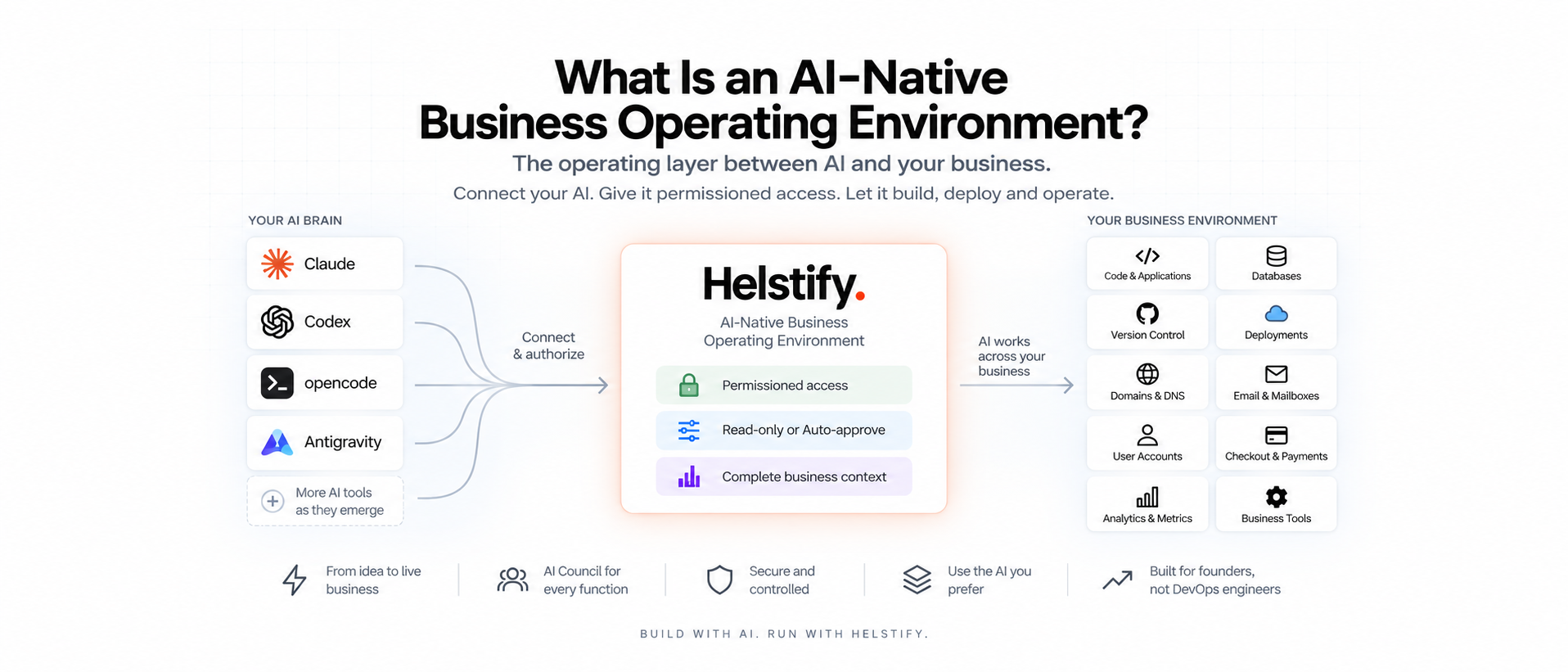
For the broader concept, see What Is an AI-Native Business Operating Environment?.
Why is AI coding only part of the opportunity?
AI coding tools are extremely useful.
They can help:
- create features
- modify code
- debug applications
- review files
- generate tests
- work with repositories
- assist with deployment tasks
But the application is only one part of the business.
A live digital business can also include:
- customers
- signups
- revenue
- payments
- domains
- infrastructure
- analytics
- marketing
- support
- deployments
- databases
- operational decisions
If AI only sees the code, it only sees one part of the problem.
If it can work with the wider business environment, its context becomes much more useful.
What does it mean for AI to operate a business?
It does not mean handing an AI unlimited control of a company.
Operating a business with AI means giving AI useful access to the systems required for specific work.
The user still determines:
- what the AI can see
- which tools it can use
- what it is allowed to change
- which decisions remain human
- what should be reviewed before execution
The operating model can range from advisory to more active execution.
For example, one task may be:
Review our signup numbers and suggest what we should investigate.
Another may be:
Inspect the application logs and determine why signup is failing.
Another may allow execution:
Fix the signup problem, test the change and deploy it.
The appropriate level depends on the task, the risk and the permissions granted.
What is an AI Council?
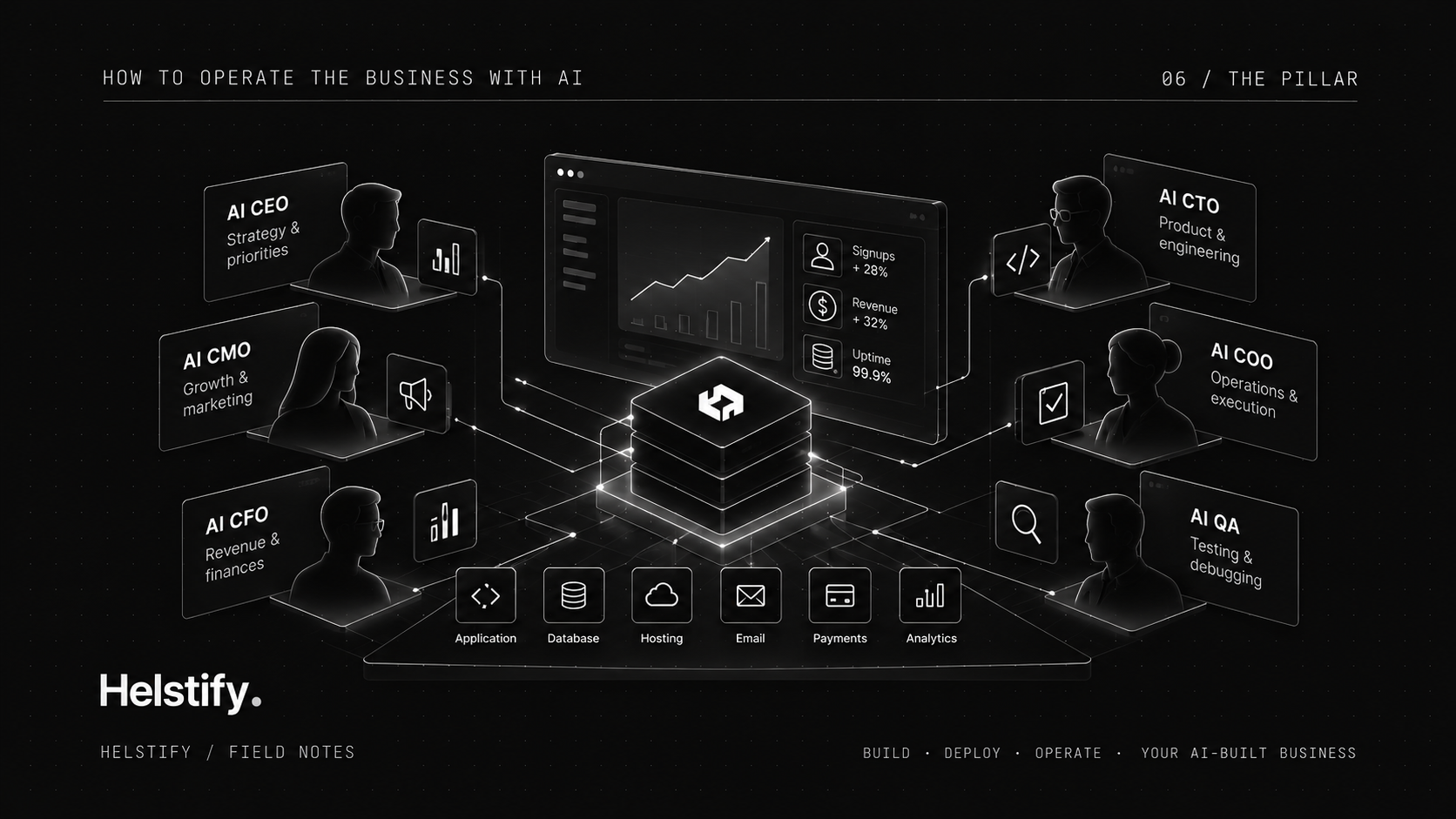
An AI Council is a role-based way of working with AI around a single business.
Instead of treating every question as a generic AI conversation, different roles look at the business from different operating perspectives.
For example:
| AI Council role | Primary perspective |
|---|---|
| CEO | Strategy, priorities and business direction |
| CTO | Technology, product and engineering |
| CMO | Growth, positioning, content and marketing |
| CFO | Revenue, pricing, cost and financial signals |
| COO | Operations, communication and execution |
| Testing & Debugging | Quality, failures and verification |
These roles do not need six separate businesses or six disconnected AI systems.
They can work from the same underlying business context.
Helstify currently uses this role-based model within its AI Council.
Why use roles instead of one generic AI assistant?
A generic AI assistant can answer questions across many subjects.
That is useful.
But business decisions often improve when the question is examined through a particular operating lens.
Consider:
Should we reduce our price?
A growth perspective may consider conversion.
A finance perspective may consider margin.
A product perspective may consider perceived value.
An operations perspective may consider service cost.
A strategy perspective may consider market positioning.
The purpose of different AI roles is not to create artificial personalities.
It is to structure reasoning around different responsibilities while keeping the same business context.
Can multiple AI roles work on the same business?
Yes, that is one of the reasons to use an AI Council model.
The roles can share the same underlying business context while examining different aspects of a question.
This is different from opening several unrelated AI chats and manually explaining the company again each time.
The useful architecture is:
One business → shared environment → shared context → different operating roles
The user can then direct the role most appropriate to the task or use a broader Council view when several functions matter.
What is an AI CEO?
An AI CEO is best understood as a strategy and prioritisation role.
It is not a legal chief executive and it does not replace the accountable human running the business.
Its job is to help think across the business rather than optimise only one function.
Useful AI CEO questions can include:
- What should we prioritise this week?
- Which problem matters most?
- Where is the biggest business risk?
- What should we stop doing?
- Which growth opportunity deserves attention?
- What are the trade-offs between these options?
- What should the other operating roles investigate?
The value comes from connecting strategic reasoning with current business context.
What is an AI CTO?
An AI CTO is a technology and engineering operating role.
It can help reason about:
- application architecture
- product changes
- bugs
- deployments
- databases
- infrastructure
- code quality
- performance
- technical risk
When the AI has permissioned access to the environment, the role can potentially move beyond recommendations and work on permitted technical tasks.
For example:
Advisory
“Review the application and identify the likely cause of this error.”
Investigative
“Inspect the logs and recent code changes and tell me what caused the problem.”
Execution
“Fix the issue, test it and deploy the permitted change.”
Which level is appropriate depends on the access granted and the importance of the system.
What can an AI CTO actually do?
The useful answer is not “everything a CTO does.”
Human CTO responsibilities include leadership, architecture judgment, hiring, security accountability, vendor relationships and organisational decisions.
AI can assist with selected technical work.
Depending on the environment and permissions available, that can include:
- inspecting code
- reviewing files
- checking logs
- investigating errors
- modifying application code
- working with databases
- reviewing recent changes
- assisting with deployments
- verifying technical results
- analysing infrastructure information
Helstify provides the environment in which a connected AI can work with available systems.
That does not guarantee every task will be completed correctly or autonomously.
The user remains responsible for deciding the appropriate level of authority.
What is an AI CMO?
An AI CMO is a growth and marketing operating role.
It can help connect product and business context with questions such as:
- Who are we trying to reach?
- Which positioning is working?
- What should we communicate?
- What should we publish?
- Which acquisition problem deserves attention?
- Where are users dropping out?
- Which campaign or message should be tested next?
The useful difference is business context.
A generic writing tool can create an advertisement.
An AI operating with business context can potentially consider the product, audience, recent activity and business priorities before recommending what to communicate.
Execution depends on which marketing tools and permissions have actually been connected.
What can an AI CFO monitor?
An AI CFO is a finance-oriented analytical role.
It can help examine available financial and commercial signals such as:
- revenue
- pricing
- payment activity
- plan mix
- costs
- margins
- growth
- changes over time
The quality of the answer depends entirely on the data available to it.
If revenue or cost information is not connected, the AI cannot reliably infer it.
This is an important principle across all AI business operations:
AI can reason from the context it has. It should not be treated as if it knows data that has never been provided or connected.
An AI CFO can support financial analysis.
It does not replace accounting, statutory reporting, tax advice or the financial responsibilities of the people operating the business.
What can an AI COO do?
An AI COO is an operations-oriented role.
It focuses on how the business is functioning day to day.
That can involve questions around:
- operational workflows
- customer communication
- recurring tasks
- process bottlenecks
- service issues
- execution priorities
- coordination between systems
For example:
Which unresolved operational issues need attention?
What has changed since yesterday?
Which customer or system issue should be handled first?
What recurring work could be automated?
The value of an AI COO increases as more of the relevant operating information exists within or is connected to the same environment.
What does the Testing & Debugging role do?
A quality role is deliberately narrower.
Its job is not to decide business strategy.
It focuses on whether something works.
That can include:
- reproducing bugs
- inspecting errors
- checking recent changes
- testing expected behaviour
- verifying a fix
- identifying regressions
- checking whether a deployment produced the expected result
This separation is useful because the AI that creates a change should not simply assume the change worked.
Verification is a separate task.
Can AI diagnose production issues?
AI can assist with production diagnosis when it has access to useful evidence.
That evidence can include:
- application logs
- error messages
- code
- recent changes
- deployment history
- server information
- database status
- configuration
- connected service information
For example, consider:
“Signup is broken.”
The cause could be:
- application logic
- authentication
- database connectivity
- configuration
- email verification
- a failed external service
- a deployment problem
A useful AI workflow is therefore:
Inspect → identify → explain → recommend → execute if authorised → verify
The AI should not simply change code because a symptom exists.
Production work benefits from diagnosis before action.
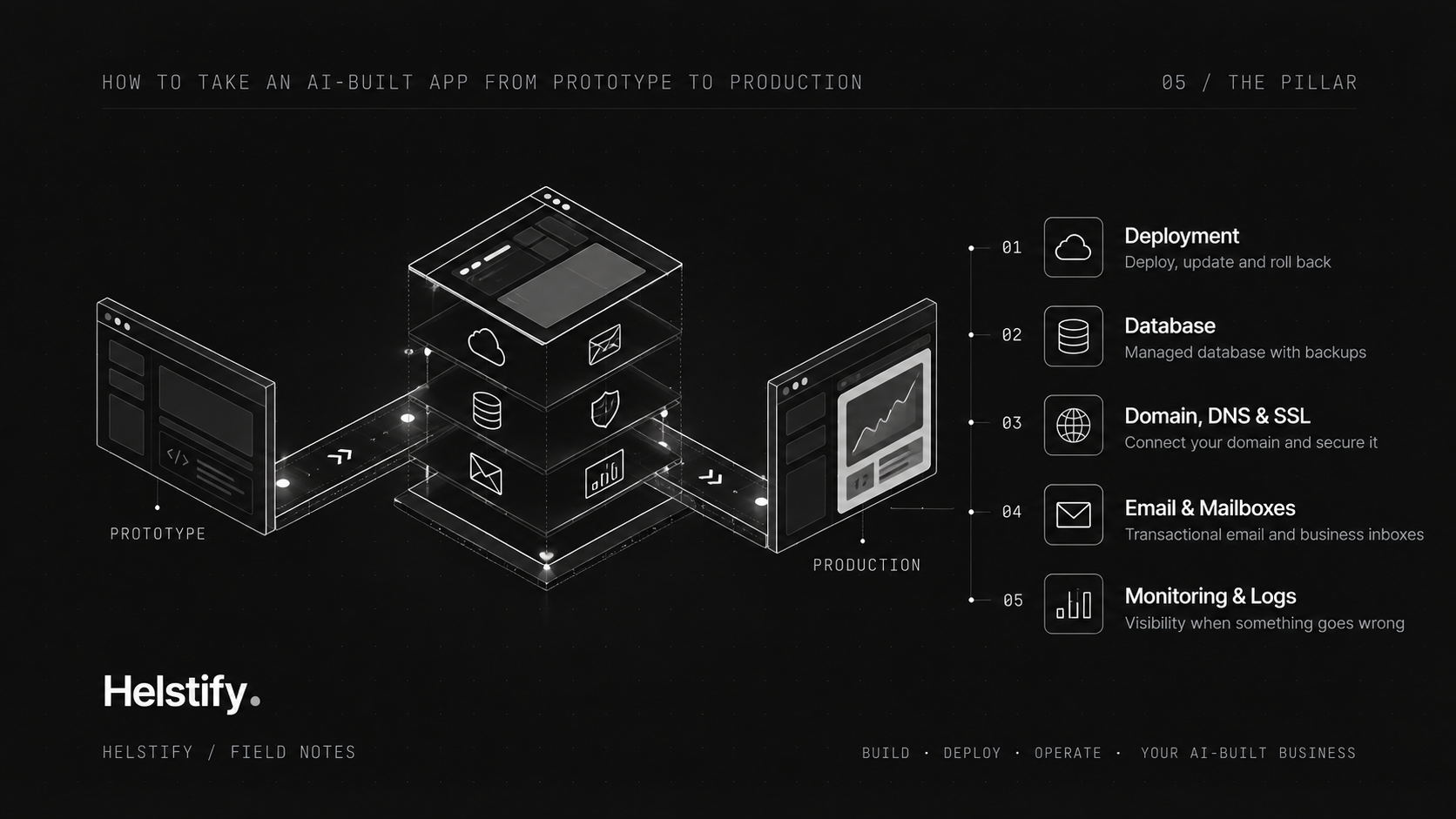
For more on production readiness, see How to Take an AI-Built App from Prototype to Production.
Can AI fix production issues?
Sometimes, where the problem is understood and the AI has the appropriate access and permissions.
But this should not be presented as a guarantee.
AI can make mistakes.
Production systems can be complex.
A fix that appears correct can create another problem.
The useful operating model is controlled execution.
For lower-risk tasks, the AI may be allowed to execute directly.
For higher-risk tasks, the user may prefer inspection, recommendation or explicit review before a change is made.
The environment should support both.
Can AI monitor revenue and signups?
AI can analyse revenue, signup or other operating metrics if those metrics are available to it.
That distinction matters.
AI cannot meaningfully monitor a metric that has never been collected or connected.
When the relevant information exists in the operating environment, AI can help answer questions such as:
- Are signups increasing or decreasing?
- When did the change begin?
- Did it follow a deployment?
- Did traffic change at the same time?
- Did payment activity change?
- Is there an unusual pattern that deserves investigation?
This is more useful than a static dashboard when the AI can reason across several connected signals.
It should still be treated as analysis, not as guaranteed causal inference.
Can AI manage deployments autonomously?
Technically, an AI can perform deployment work when the environment exposes deployment capabilities and the AI has permission to use them.
Whether it should do so automatically is a different question.
Deployment authority should depend on factors such as:
- environment
- risk
- application importance
- testing
- rollback capability
- user permissions
- business policy
A low-risk content update may justify greater automation.
A change involving customer data or payments may justify more review.
The useful principle is:
Autonomy should be scoped to the task, not assumed for the entire business.
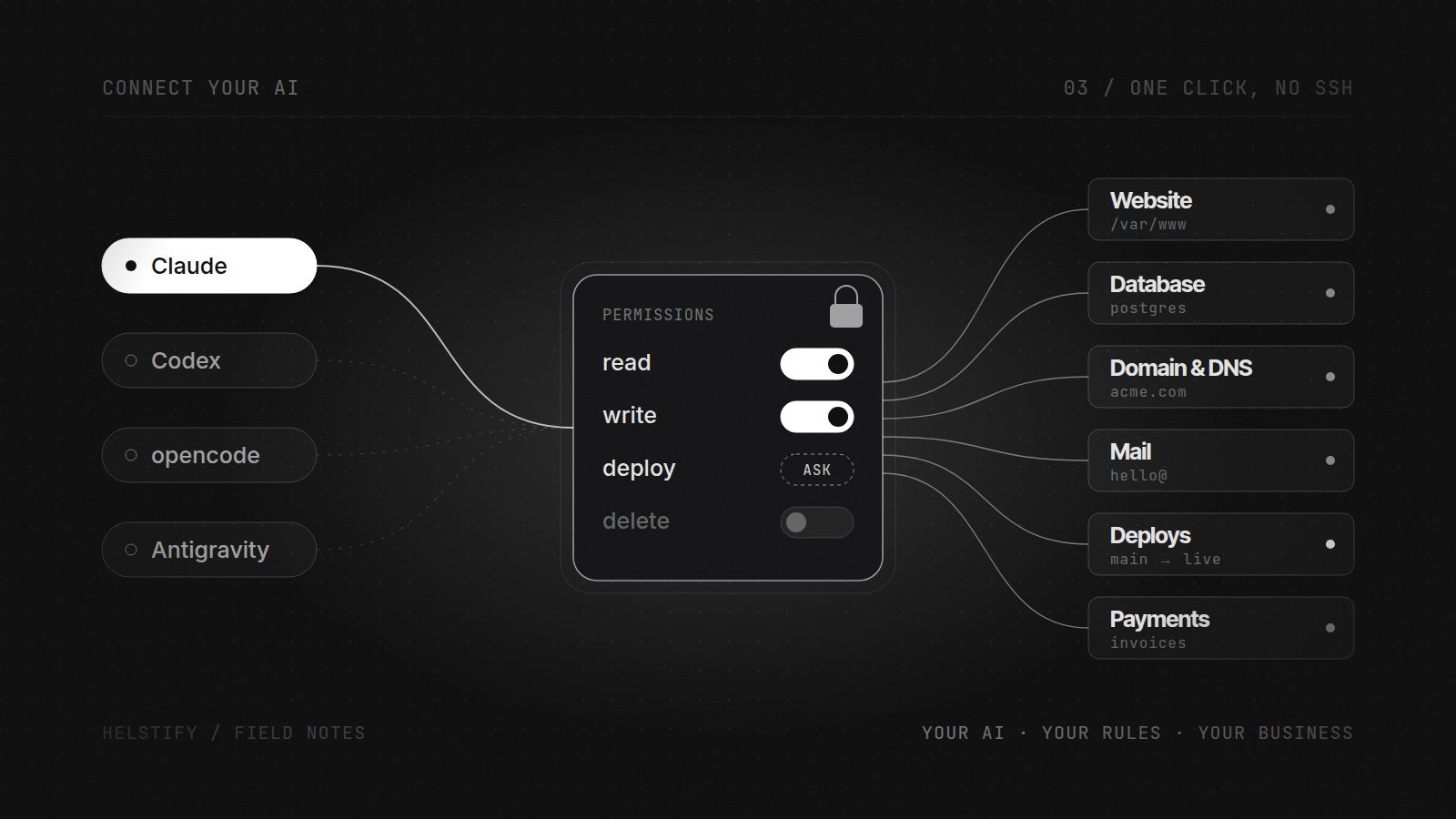
Helstify supports a permissioned model rather than requiring unrestricted access.
What is the difference between Read-only and execution access?
Read-only access is useful when the AI needs to inspect and reason without changing the environment.
For example:
“Check why the last deployment failed.”
The AI can investigate available information and provide its conclusion.
Execution access allows the AI to perform permitted work.
For example:
“Fix the configuration issue and restart the application.”
The correct level depends on the task.
The principle is simple:
Visibility does not have to mean authority.
The user can separate what AI is allowed to understand from what it is allowed to change.
Read more in Connect Your AI to Your Business and Let It Work.
What are AI agents for business operations?
An AI agent is useful when it can do more than generate a response.
In an operating context, an agent can be given:
- a goal
- relevant context
- tools
- access
- constraints
- permission to perform specific actions
For example:
A coding assistant may tell you which command to run.
An operating agent with the correct access may be able to run the permitted command.
A marketing assistant may suggest a content update.
An operating agent connected to the relevant system may be able to prepare or publish the permitted change.
A finance assistant may explain how to analyse revenue.
An operating agent with access to the relevant data may be able to perform the analysis directly.
The environment determines what actions are actually possible.
AI executive team vs individual AI assistants
The difference is primarily context and coordination.
Individual AI assistants often work independently.
You may have:
- one coding assistant
- one writing assistant
- one analytics assistant
- one research tool
- one support tool
Each may be good at its job.
But the founder often becomes the integration layer.
Information has to be copied between systems.
Business context has to be repeated.
Recommendations may conflict.
An AI Council model starts from a different architecture:
One business environment. Shared context. Different operating roles.
This does not make every answer automatically correct.
It reduces fragmentation.
Why does shared business context matter?
Consider this question:
Why did revenue fall this week?
A finance-only view may show lower revenue.
A growth view may show fewer signups.
A technical view may show a checkout failure.
An operations view may show a deployment happened just before the decline.
Looking at only one system could lead to the wrong conclusion.
Shared context makes it possible to investigate across boundaries.
That is particularly valuable for small teams where one founder is already thinking across every business function.
Can AI move from recommendation to execution?
Yes, but only when three things are present:
The environment
The system where the work needs to happen must be accessible.
The tools
The AI needs a way to perform the required task.
The permission
The AI must be authorised to perform that action.
Without those three things, AI remains an adviser.
This is the fundamental architecture behind Helstify.
Models provide intelligence. Helstify provides the environment, tools, permissions, business context and execution.
Execution here does not mean that Helstify guarantees every AI request will succeed.
It means the environment gives the connected AI a controlled path to perform work rather than only describe it.
Why permissions matter more as AI becomes capable
The more capable AI becomes, the more important access control becomes.
An AI that can only answer a question creates limited operational risk.
An AI that can modify code, send email or deploy an application requires much stronger controls.
Useful questions include:
- What systems can it access?
- Is the access read-only or writable?
- Which actions are permitted?
- Can access be withdrawn?
- Is the activity visible?
- Which tasks should always require human judgment?
The goal is not maximum autonomy.
The goal is appropriate autonomy.
What should remain a human decision?
AI can increase the amount of work that can be delegated.
It does not remove human accountability.
Founders and operators should retain judgment over decisions such as:
- company direction
- legal commitments
- financial commitments
- regulatory matters
- high-impact pricing changes
- destructive data changes
- sensitive customer decisions
- access permissions
- material production changes
How much review is appropriate depends on the business.
A low-risk internal tool and a financial application should not use the same operating policy.
Does an AI Council replace employees or executives?
That is not the most useful way to think about it.
An AI Council is a way to organise AI work around business responsibilities.
In a solo business, the founder may use it as additional operating capacity.
In a small team, it may help with analysis, execution and coordination.
In a larger organisation, it may assist people already responsible for those functions.
The role name describes the perspective.
It does not transfer legal or managerial accountability from the people running the company.
Can a solo founder operate with an AI Council?
This is one of the strongest use cases.
A solo founder already switches between roles constantly.
One hour may involve product.
The next involves marketing.
Then billing.
Then a customer issue.
Then a deployment.
Then analytics.
An AI Council gives those responsibilities a more structured interface.
Instead of pretending the founder only has one job, the environment reflects how an early-stage business actually operates.
What can the Full Council do?
Some questions should not belong to only one role.
For example:
Should we launch a lower-priced plan?
That question may involve:
- CEO: strategy
- CMO: acquisition and positioning
- CFO: revenue and margin
- CTO: product implications
- COO: operational implications
A Full Council view can bring those perspectives together before presenting a consolidated recommendation or plan.
The purpose is not to generate six separate essays.
It is to make cross-functional reasoning available without forcing the founder to manually coordinate several AI conversations.
What information does the AI Council need?
Useful AI business operation depends on useful context.
That context can include:
- the application
- code
- database
- customers
- payments
- analytics
- infrastructure
- operational history
- business profile
- current goals
Not every role needs access to everything.
Permissions should reflect the work being performed.
For example, a marketing analysis may not require infrastructure credentials.
A debugging task may not require financial information.
Good AI operations require both context and restraint.
Does AI need access to every business tool?
No.
Connect what creates useful operating context.
Adding unnecessary access can create complexity and risk without improving the result.
A sensible approach is:
Start with the minimum access needed for the task.
Expand it when there is a clear reason.
This principle applies to both individual agents and the broader Council.
How does Helstify fit?
Helstify provides the environment in which the AI you choose can work with the business.
The environment can bring together areas such as:
- application and code
- database
- deployments
- domain and DNS
- payments
- customers
- analytics
- operational tools
The AI provides the reasoning capability.
Helstify provides the place where that reasoning can interact with the business.
Permissions determine what the AI is allowed to do.
Business context helps it understand what it is working on.
The user remains in control of the objective and the authority granted.
What can Helstify's AI Council do today?
The available role-based Council is organised around business functions including strategy, technology, growth, finance, operations and testing.
The exact level of execution can depend on the plan, connected systems and permissions available.
That is important.
The Council should not be described as automatically running every function of every business.
Its usefulness depends on:
- what is connected
- what information exists
- what tools are available
- what permission the user grants
- what the selected AI can successfully do
Helstify provides the operating environment.
The AI works within it.
The user directs it.
What should happen when AI is uncertain?
Uncertainty should not automatically trigger action.
A useful operating system should allow a task to stop at analysis or recommendation when execution is inappropriate.
For example:
“I cannot determine whether this payment configuration is correct from the information available.”
is better than making an unsupported production change.
Likewise:
“The logs suggest two possible causes. Here is what should be checked next.”
can be more useful than pretending there is certainty.
AI operations should make uncertainty visible rather than hide it.
What does good AI business operation look like?
It is not a business running without people.
It is a business in which the distance between intention and execution becomes shorter.
The founder can increasingly say:
Investigate this.
Analyse this.
Build this.
Check this.
Change this.
Deploy this.
Verify this.
And the AI can work with the systems required for that task, within the access it has been given.
That is fundamentally different from a chatbot that ends every answer with instructions for the founder to execute manually.
Frequently asked questions
Can AI operate a business after launch?
AI can assist with operating work after launch when it has access to the relevant context, tools and permissions. The amount of work it can perform depends on what is connected and what authority the user grants.
What is an AI CTO?
An AI CTO is a role focused on technology, engineering, product systems and technical operations. It can analyse technical questions and, where authorised, work on permitted technical tasks.
Can an AI CTO replace a human CTO?
It should not be treated as a direct replacement for the leadership, accountability and organisational responsibilities of a human CTO. It is a way to apply AI to CTO-type work.
What is an AI CMO?
An AI CMO is a growth and marketing role that can help analyse positioning, acquisition, content and marketing activity using the business context available to it.
What can an AI CFO monitor?
It can analyse available revenue, pricing, payment, cost and other financial signals. It cannot accurately analyse information that has not been provided or connected.
Can AI manage startup operations?
AI can help with operational analysis and permitted tasks when the relevant tools and business context are available.
Can AI fix production problems?
AI can help diagnose and sometimes fix production problems when it has sufficient evidence, tools and permissions. Results should not be assumed or guaranteed, particularly for high-risk production systems.
Can AI monitor revenue and signups?
Yes, if those metrics are collected and available to the AI. It can analyse trends and investigate changes, but it should not invent missing data or assume causation.
Can AI deploy autonomously?
It can perform deployment actions when the deployment environment supports them and the AI has permission. Whether deployments should occur without review is a separate policy decision for the business.
Can multiple AI roles work on one business?
Yes. A role-based Council can use shared business context while examining problems through different functional perspectives.
Is an AI Council just several chatbots?
It should not be. The useful difference is shared business context, access to a common operating environment and the ability for permitted work to move from reasoning toward execution.
Does Helstify guarantee autonomous operation?
No. Helstify provides the environment, tools, context and permission model. What the connected AI can successfully do depends on the task, available systems, selected AI, plan and access granted.
The operating principle
AI coding changed how quickly a founder can create software.
The next change is what happens after the software exists.
The opportunity is to move from:
AI that tells you what to do
to:
AI that can work on the business within the authority you give it.
That requires more than a model.
It requires:
intelligence + environment + context + tools + permissions
That is the role of the operating layer.
Models provide intelligence. Helstify provides the environment, tools, permissions, business context and execution.
Build with AI. Run with Helstify.